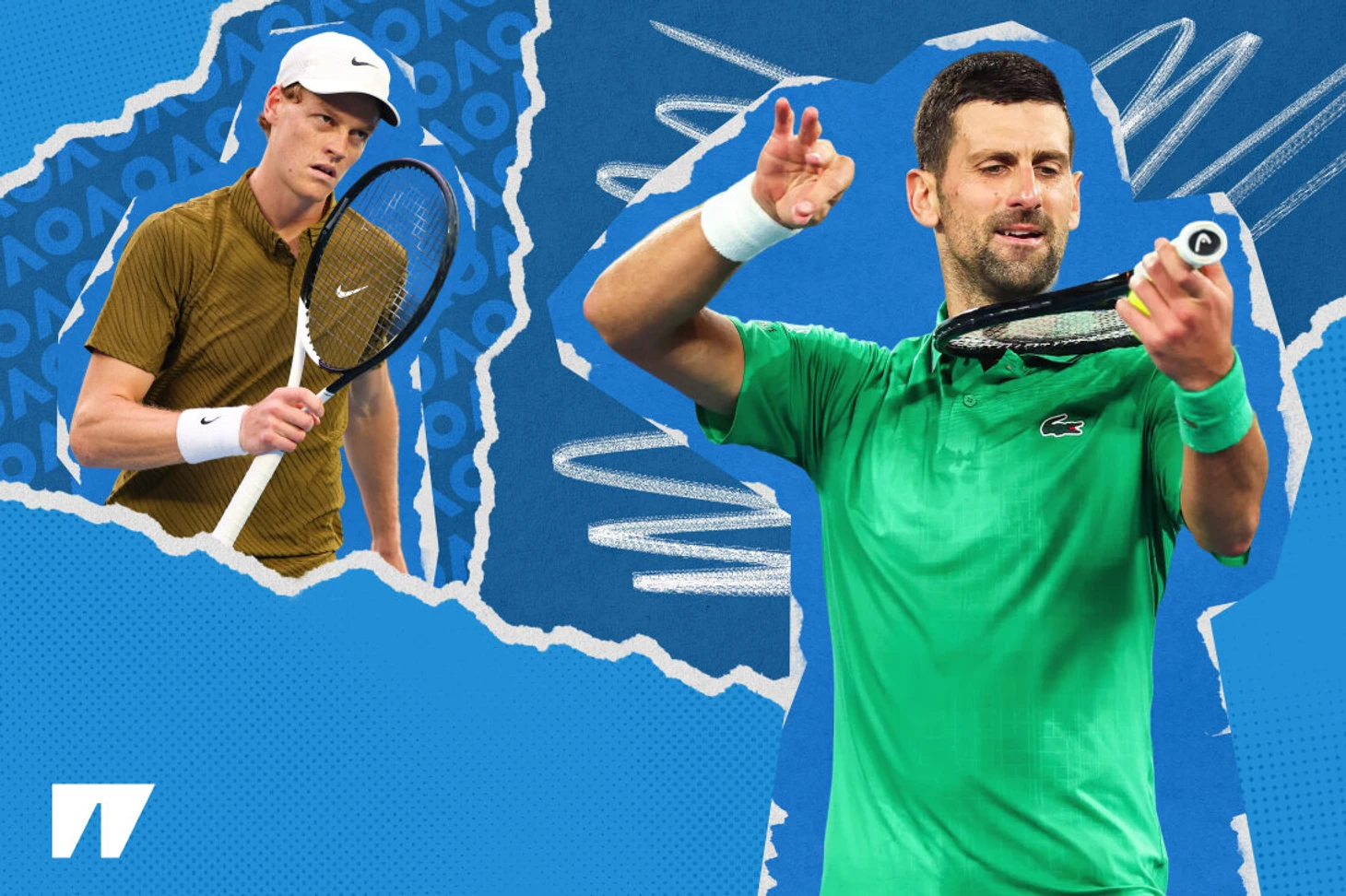
Novak Djokovic delivered one of the most remarkable performances of the 2026 Australian Open, eliminating Jannik Sinner in a dramatic five-set semifinal: 3–6, 6–3, 4–6, 6–4, 6–4. The victory ended Sinner’s long unbeaten run in Australia and sent Djokovic into yet another Grand Slam final — a testament to longevity, adaptability, and competitive greatness.
The result was all the more striking given the context of Djokovic’s tournament run.
A Unique Road to the Semifinal
Before facing Sinner, Djokovic had not played a single completed set on the second week of the Australian Open. In the fourth round, Jakub Mensik withdrew before the match, while Lorenzo Musetti retired during the quarterfinal after leading two sets to love.
Against Sinner, however, there were no shortcuts.
Djokovic had not beaten the Italian since 2023 and had lost five consecutive matches to him, including every meeting since the Australian Open 2024. At nearly 39 years old, Djokovic entered the semifinal as the underdog — at least on paper.
Yet his mindset was clear. Earlier in the week, Djokovic stated:
“If nothing is bothering me physically and I’m playing well, I always have a chance. This is a Grand Slam semifinal — my confidence and motivation are high. Without them, there is no point in competing.”
He also rejected the idea of surrendering ground to the new generation:
“Are Sinner and Alcaraz playing at an incredible level? Yes. Does that mean I walk onto the court with a white flag? No. I will fight until the last point.”
On Friday night in Melbourne, he did exactly that.
Key Tactical Factors Behind Djokovic’s Victory
1. Elite Serving Under Pressure
Djokovic’s serving performance was exceptional, especially on break points. He saved 16 of 18 break points, repeatedly finding precise first serves when it mattered most. The flat ace down the T became his go-to weapon in critical moments.
2. Aggressive Second Serve
Notably, Djokovic increased the average speed of his second serve to 162 km/h, well above his tournament average of 156 km/h. This adjustment paid off in key situations, preventing Sinner from stepping inside the court and attacking.
Two moments stood out:
- While serving for the second set, Djokovic opened with a double fault but immediately recommitted to aggressive second serves.
- At 4–3 in the fifth set, Sinner failed to capitalize on a break point due to another forceful second serve from Djokovic.
3. Proactive Baseline Aggression
Rather than relying solely on defense, Djokovic played with sustained aggression, particularly off the forehand. His flatter, heavier shots consistently forced Sinner into uncomfortable positions and disrupted the Italian’s preferred rhythm.
4. Forcing Shots Out of Balance
Djokovic repeatedly moved Sinner laterally along the baseline, stretching him to extreme positions. This had two effects:
- It opened space for Djokovic to attack into the open court.
- It destabilized Sinner’s normally reliable cross-court backhand, leading to an unusually high error count from that wing.
5. Exploiting Directional Changes
Djokovic frequently caught Sinner wrong-footed, especially during longer exchanges. Even when Sinner reached the ball, balance issues often resulted in errors.
6. Mental and Defensive Toughness
At 1–2 in the fifth set, Djokovic escaped from 15–40 with a spectacular backhand down the line, followed by an equally bold forehand winner. These moments defined the match psychologically.
7. Physical Parity
Despite visible discomfort — Djokovic briefly clutched his chest during the third set — there was no evident drop in his movement or endurance. In extended rallies, he matched Sinner step for step.
A pivotal rally at 3–3 in the fifth set, which Djokovic eventually won, proved decisive on the path to the crucial break.
8. Uncharacteristic Errors from Sinner
Sinner struggled to find consistency under sustained pressure. Several costly mistakes stood out, including:
- A mishit return on a manageable second serve at 2–1 in the fifth set
- Consecutive errors at 3–3, 40–40, followed by a backhand long on a critical break point at 4–3
9. Return Pressure Despite Strong Serving
Although Sinner set a personal record for aces in the match, Djokovic capitalized whenever the first serve percentage dropped, applying relentless pressure and forcing rushed decisions.
10. A Performance Beyond Statistics
Sinner’s difficulties do not diminish the magnitude of Djokovic’s performance. This was not simply about errors — it was a display of tactical clarity, competitive courage, and championship-level execution.
What Comes Next: Australian Open Final Preview
With the win, Djokovic advanced to his 38th Grand Slam final and his 11th Australian Open final, further extending his all-time records. Awaiting him is Carlos Alcaraz, who will contest his first Australian Open final.
Djokovic currently leads their head-to-head 5–4, setting the stage for another high-profile rivalry chapter.
The final will take place on 1 February, with a start time of 15:30 WIB (Indonesia Western Time).
Betting Market Snapshot
- Alcaraz to win the final: 1.33
- Djokovic to win: 3.60
- Over 36.5 games: 1.74
- Five-set match: 3.65
Whether Djokovic can overcome the odds and claim a 25th Grand Slam title remains the final question of the tournament.